
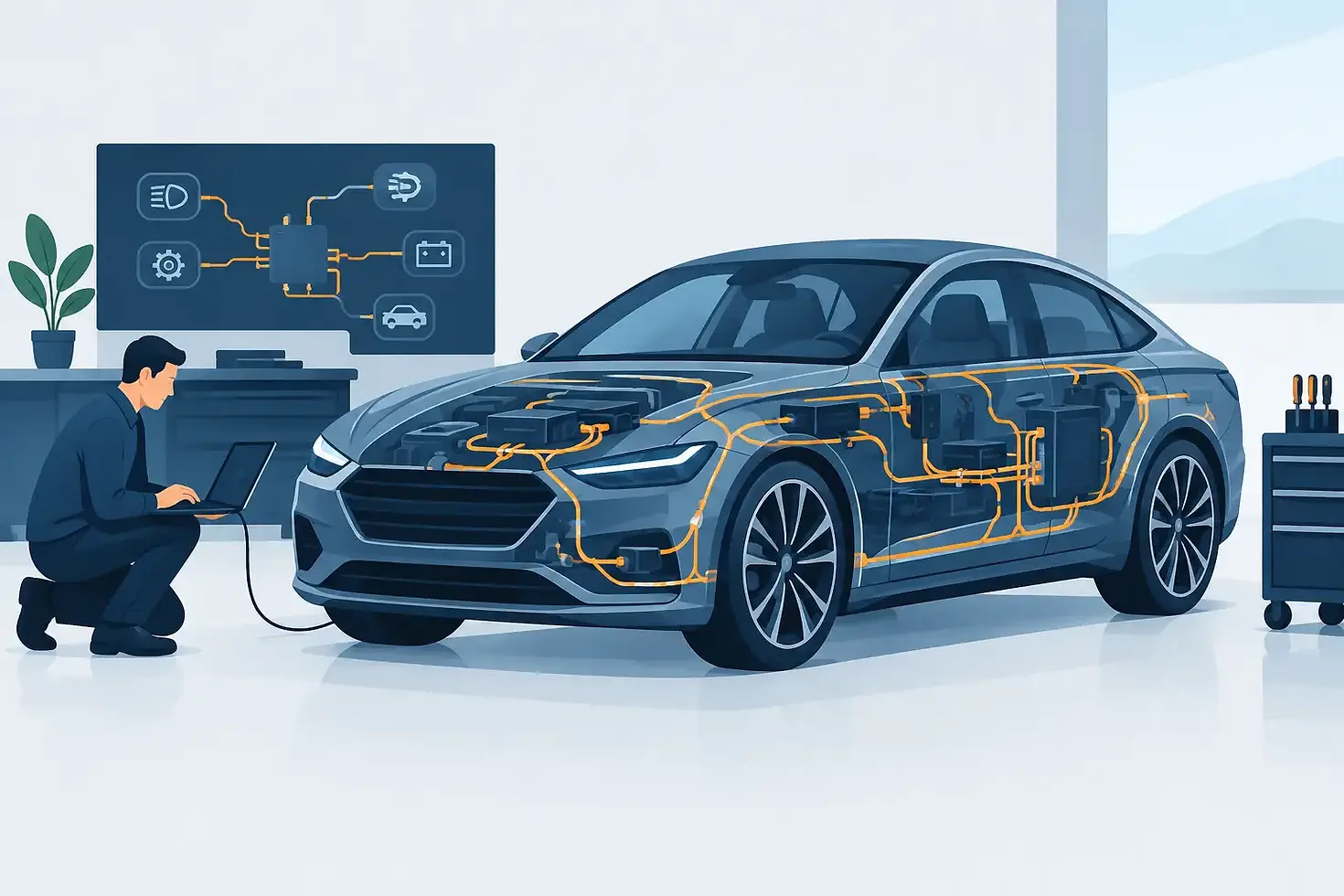
Bespoke Automotive Electrical Integration
A modern prestige vehicle can have more than 70 control units communicating across its electrical architecture. Add one poorly chosen accessory or an untidy splice, and a simple upgrade can become the source of warning lights, battery drain or intermittent faults. Bespoke automotive electrical integration takes a different approach: every addition is planned around the vehicle’s existing systems, fitted discreetly and calibrated to behave as though it belongs there.
For owners who value factory finish, the difference is immediately apparent. A reverse camera should appear on the original display when reverse is selected. Folding mirrors should respond through the correct controls. A security system should protect the vehicle without advertising its presence. The standard is not merely that the upgrade works. It should work with the same confidence, logic and visual restraint as the rest of the car.
What bespoke automotive electrical integration involves
This is more than installing a component and connecting a live feed. It is the careful design and installation of electrical upgrades that communicate safely with the vehicle, preserve its original appearance and support reliable long-term ownership.
Depending on the vehicle and the brief, the work may include genuine parking sensors, reverse camera systems, heated seats, power-folding mirrors, additional control modules, replacement cable harnesses, OEM infotainment functions or discreet vehicle security. Each system has its own requirements, but the principles remain the same: use compatible components, follow the correct electrical pathways and protect every connection from movement, moisture and unwanted interference.
On many Audi, BMW, Mercedes-Benz, Porsche, SEAT and Skoda models, the vehicle network is as important as the hardware itself. CAN bus communication, module coding, gateway permissions and correctly configured control units can determine whether an upgrade behaves like original equipment or becomes an ongoing compromise. A specialist integration considers all of this before trim is removed.
Factory-quality results begin before installation
The strongest retrofit work is decided at the assessment stage. Vehicle specification, model year, existing options and control-unit versions all matter. Two cars that look identical can have different looms, infotainment generations or gateway configurations, which changes what is possible and how it should be completed.
A considered assessment establishes whether an OEM route is available, whether a dedicated retrofit harness is required, and whether coding or parameterisation will be needed afterwards. It also identifies limitations early. For example, a camera may be technically possible but require a different handle assembly or a compatible display module. Heated seats may need more than elements and switches if the car lacks the relevant climate-control support. Clarity at this point prevents the disappointing situation where a vehicle has been dismantled before a compatibility issue is discovered.
There is also a practical question of ownership. An upgrade should be serviceable. Future diagnostics should remain straightforward, fuses should be correctly rated and accessible, and the installation should not create uncertainty for another qualified technician later. Precision engineering is not hidden complexity. It is a clean, logical solution that respects the car.
Why OEM integration is worth the investment
Universal aftermarket products can offer a lower initial price and, in some applications, they are entirely appropriate. A standalone camera display in a working vehicle, for instance, may be a sensible answer where originality is not a priority. Yet on a well-specified European car, a universal solution often introduces visible compromises: extra screens, non-matching switches, exposed wiring or operating behaviour that does not feel native to the vehicle.
OEM-style integration is built around a higher expectation. Components are selected for fit, electrical compatibility and the way they interact with existing controls. Parking sensors can use factory-style buzzers and visual displays. Cameras can use the original screen. Folding mirrors can be activated through the vehicle’s central locking logic or mirror-control switch, where the platform supports it.
This approach also protects the cabin environment. No owner wants a premium interior spoiled by an ill-fitting button, a cable routed across a footwell or trim that no longer sits correctly. The best electrical retrofit leaves little evidence of the work, apart from the additional capability it delivers.
That does not mean genuine parts are automatically the right answer in every case. Older vehicles, rare specifications and discontinued components can make a complete OEM conversion disproportionately expensive. A high-quality specialist solution, installed with the same care and using vehicle-specific harnessing, can be the more intelligent choice. The objective is not to fit parts simply because they carry a manufacturer label. It is to achieve the most dependable, refined result for the particular vehicle.
Security that remains discreet
Electrical integration plays a defining role in modern vehicle security. Theft methods have evolved, particularly for keyless and high-demand vehicles, so visible deterrents alone are rarely enough. A professionally installed Ghost Immobiliser adds an intelligent layer of protection by requiring a personalised sequence through existing vehicle controls before the engine can be authorised to start.
Its strength lies in discretion. There is no additional fob to identify, no conspicuous keypad and no alteration to the vehicle’s cabin design. However, a security device is only as good as its installation. Correct positioning, protected wiring, reliable connections and appropriate configuration are fundamental. Poor fitment can undermine both security and day-to-day usability.
The same principle applies to trackers, alarm interfaces and camera systems. Electrical security should enhance peace of mind without introducing nuisance alerts, parasitic battery drain or clues that reveal how the system has been fitted. For a valued daily driver or weekend performance car, that balance matters.
The details that separate a clean installation
Quality is often visible in what cannot be seen. Trim should be removed with the proper tools and refitted without marks, rattles or broken clips. Wiring should follow protected factory routes where appropriate, be secured against abrasion and avoid heat sources, airbags, pedal assemblies and moving mechanisms.
Connections require equal discipline. Random Scotchlok-style taps and twisted, taped joins have no place in a premium retrofit. Correct terminals, sealed connectors, suitable sleeving and purpose-built looms offer a more reliable foundation. Power feeds need proper fuse protection, while earth points must be selected and prepared correctly. These details prevent faults that may only emerge months later, often after vibration, damp weather or repeated use.
Coding is the final engineering layer. Once hardware has been fitted, the vehicle may need to recognise a new module, activate a menu option or remove diagnostic faults generated during installation. Functional checks should cover more than the headline feature: ignition cycles, locking operation, reverse selection, display response and fault-memory inspection all help confirm the system is operating as intended.
Choosing the right integration for your car
The most effective upgrades usually solve a specific frustration or improve a part of ownership that matters to you. A reverse camera can make a long saloon or SUV easier to place in tight spaces. Genuine front and rear parking sensors add confidence in urban driving. Heated seats transform cold winter journeys, while power-folding mirrors can protect the car in narrow streets and car parks.
Security often comes first for owners of desirable models. For others, the priority is restoring an original feature missing from a used vehicle’s specification. There is no single ideal upgrade package. The right decision depends on the vehicle, how it is used, its current specification and whether you prioritise convenience, protection, resale appeal or all three.
Before committing, ask whether the proposed solution uses vehicle-specific parts or generic hardware, how the wiring will be protected, whether coding is included, and what testing is carried out after fitment. These are more useful questions than simply asking how quickly an accessory can be installed. They reveal the installation standard you are buying.
Professional fitting or self-installation?
Hands-on owners can successfully complete certain upgrades, especially when supplied with the correct components, dedicated harnesses and clear vehicle-specific guidance. This can be rewarding, and it offers control over the project. Yet the margin for error is narrower on modern cars than many people expect.
Airbag-adjacent trim, vehicle networks, security systems and high-current circuits are generally best left to a specialist. An incorrect connection can cause faults that are difficult to trace, while poor routing may create a safety concern long after the initial installation. Professional fitting is particularly valuable where coding, module programming or interior dismantling is involved.
Retro Fit Cars approaches each project with that factory-minded discipline: understanding the vehicle first, then delivering the upgrade with craftsmanship, innovation and appropriate technical restraint. The result is not an accessory attached to a car, but a carefully integrated improvement that makes every journey feel more considered.
Choose upgrades that respect the engineering already in your vehicle. When the installation is planned with precision, the technology fades into the background and the benefit becomes part of the drive.


Comments