
Wired Versus Wireless Reverse Cameras Compared
- Aaron Mafi
- 7 days ago
- 6 min read
A reverse camera is only useful when it delivers a clear, immediate image at the precise moment you select reverse. That is why the choice between wired versus wireless reverse cameras deserves more thought than simply choosing the quickest installation. On a prestige vehicle, the system should feel like it was specified with the car: discreet, dependable and integrated with the existing display or a high-quality dedicated screen.
For some owners, wireless technology is the practical answer, particularly where fitting a cable through a caravan, horsebox or long vehicle would be disruptive. For most permanent passenger-car retrofits, however, a professionally installed wired system remains the reference point for image stability, response time and factory-quality presentation.
Why the connection type changes the ownership experience
Every reverse camera has the same basic task. A camera at the rear of the vehicle captures the area behind it and sends a video signal to a display. The difference lies in how that signal travels.
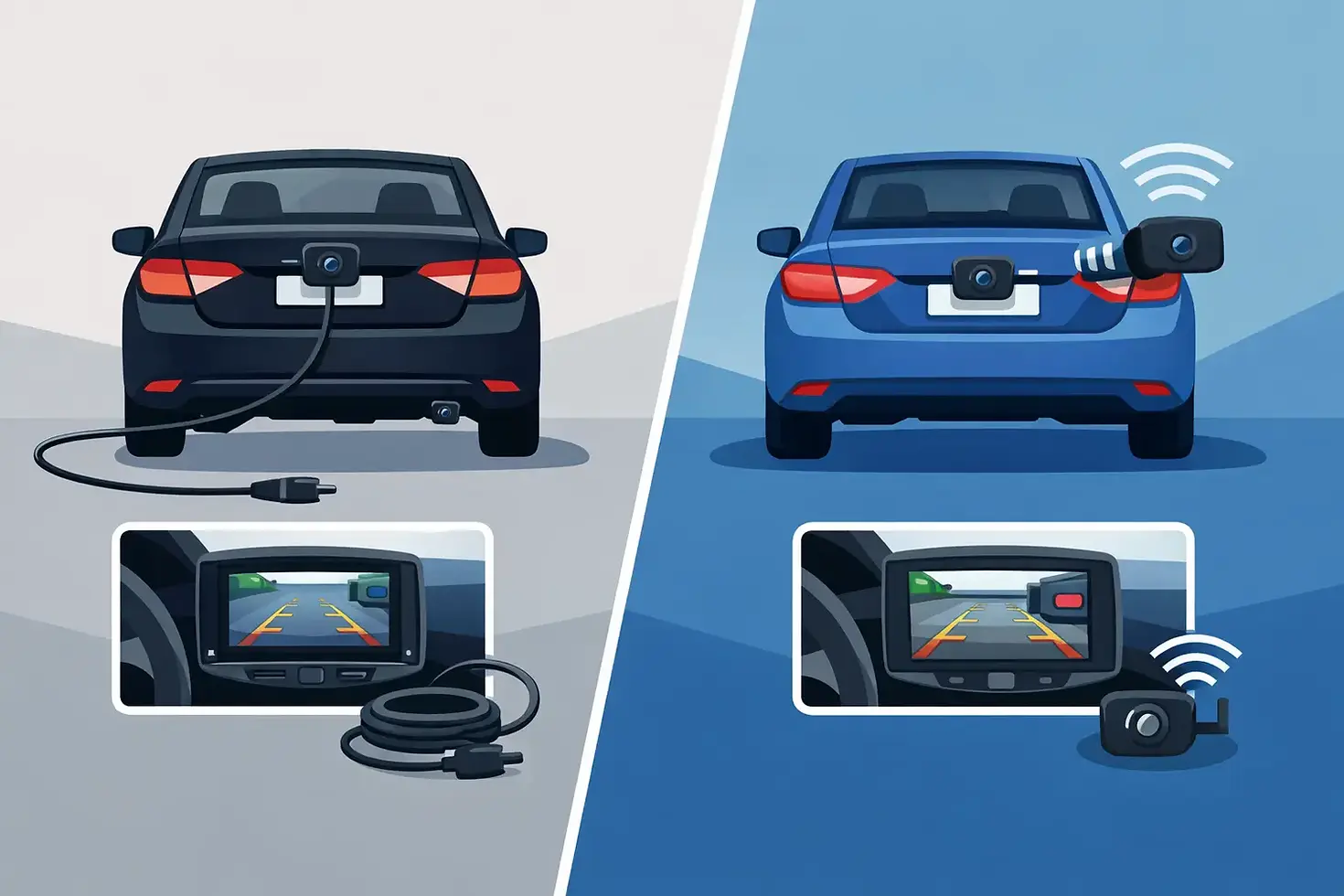
A wired reverse camera uses a physical video cable, usually routed from the tailgate or rear bumper area through the vehicle to the infotainment screen or interface. It may also require carefully managed power, earth and reverse-trigger connections. The work is more involved, but the signal path is controlled from end to end.
A wireless reverse camera transmits the video signal by radio frequency from a rear transmitter to a receiver behind the display. It still needs power at the camera end and usually at the receiver, so it is not genuinely cable-free. What it avoids is the long video run through the cabin.
That distinction matters. A well-engineered retrofit is not judged only on whether the camera turns on. It is judged by how quickly it responds, how cleanly it performs in difficult conditions and how neatly every component disappears into the vehicle.
Wired versus wireless reverse cameras: the real differences
Image stability and signal reliability
A wired camera has a direct connection, making it inherently less vulnerable to interference. This is particularly valuable in built-up areas, on busy driveways and around vehicles with multiple electronic systems. The image is typically more consistent, with less risk of momentary drop-out, flicker or visible noise.
Wireless systems have improved significantly, especially digital kits designed for automotive use. Yet radio signals must contend with distance, vehicle bodywork, metal panels, tinted glass, other wireless devices and local interference. A short-wheelbase hatchback may give a wireless setup an easy job; a large SUV, van, motorhome or vehicle towing a trailer can make the environment less forgiving.
For an owner who expects the camera to work every time, in every car park and in poor weather, a wired signal provides greater peace of mind.
Response time when selecting reverse
Reverse cameras should feel immediate. With a direct wired feed, the display can normally switch to the camera image with minimal delay once reverse is selected. This matters when manoeuvring precisely into a narrow bay, reversing close to a wall or aligning a towbar.
Wireless systems can introduce a small amount of transmission latency. Often it is modest, but it varies by equipment quality and operating conditions. A delayed image is not necessarily unsafe at low speed, yet it can feel less refined and less predictable than an OEM-style wired installation.
Picture quality and low-light performance
Connection type does not determine camera sensor quality on its own. Resolution, lens design, dynamic range and infrared or low-light capability all play a role. However, a wired connection is better placed to preserve the signal from a high-quality camera, particularly where the installation uses an interface designed to display video cleanly on the original infotainment screen.
A poor camera on a wired installation will still produce a poor picture. Equally, an excellent wireless camera may look impressive in ideal conditions. The difference is that a properly specified wired system gives premium hardware the best chance to perform consistently, rather than compressing or disrupting the image in transmission.
Installation complexity and vehicle preservation
This is where wireless systems have a clear appeal. Without a long video cable to route, installation can be faster and may require less dismantling. It can suit a temporary setup, a work vehicle where convenience takes priority, or a situation where access through the body is unusually difficult.
The trade-off is that wireless components still need to be located, powered and protected from moisture. A transmitter hidden behind a trim panel must be securely mounted, properly insulated and positioned to achieve a stable signal. Quick-fit does not excuse untidy wiring or exposed connections.
A wired installation demands more craftsmanship. Cables should follow factory routes wherever possible, be protected from abrasion, avoid moving tailgate mechanisms and be secured without rattles. On vehicles with original displays, the interface and camera activation should work in harmony with the car’s electrical architecture. Done correctly, it leaves no visible evidence of the engineering behind it.
Suitability for OEM-style integration
Owners of Audi, BMW, Mercedes-Benz, Porsche, SEAT, Škoda and similar marques often want the reverse camera to appear on the factory screen, activate through the correct gear selection and retain a clean cabin. Wired systems are generally the stronger choice for this objective.
They support the stable video feed required by vehicle-specific interfaces and can be paired with discreet camera housings integrated into a boot handle, number-plate light surround or original-style mounting point. Dynamic parking guidelines, where supported by the vehicle and interface, are also more naturally delivered through a carefully planned wired retrofit.
Wireless cameras are more often paired with an additional display or a universal receiver. That can be perfectly functional, but it rarely achieves the same visual and operational cohesion as a factory-inspired installation.
When wireless is the sensible choice
Wireless should not be dismissed as a lesser technology. It is the right answer in certain applications, provided expectations are realistic and the equipment is specified properly.
It can be especially practical for trailers, caravans, horseboxes and detachable rear equipment, where running a permanent cable between the towing vehicle and the rear camera would be inconvenient. It may also suit owners who need a rear-view aid quickly on an older vehicle and do not require integration with the original head unit.
The strongest wireless installations use quality digital transmission, carefully chosen mounting positions and protected power connections. Before committing, consider the distance from camera to receiver, the amount of metal between them and whether the vehicle regularly operates around sources of electrical interference.
When wired is worth the additional installation work
Choose wired when the camera will be a permanent enhancement to a vehicle you intend to keep, when you value an OEM-style result, or when dependable performance matters more than the shortest fitting time. It is also the better option for vehicles with a tailgate, where correct cable routing through the factory gaiter protects the installation from repeated movement.
A wired system is particularly well suited to drivers who use confined car parks, have low rear visibility, tow regularly or simply expect their vehicle’s technology to behave with factory precision. The greater installation investment is spent on the parts nobody sees: correct loom routing, secure connections, compatible interfaces and calibration where required.
The specification matters as much as the wiring
The best choice is not merely wired or wireless. It is a complete system chosen for the vehicle and installed to a professional standard. A premium reverse camera retrofit should account for the camera’s field of view, its location, waterproofing, night performance, image orientation, display compatibility and the method used to trigger it.
A camera mounted too low can make kerbs look misleadingly close. One mounted too high may lose useful detail immediately behind the bumper. Generic grid lines can be useful, but they are not a substitute for understanding the camera perspective. The right camera position and viewing angle make the image genuinely useful rather than merely impressive on first demonstration.
Electrical integration also deserves attention. Modern vehicles monitor circuits closely, and careless connections can create faults, warning messages or intermittent operation. Specialist installation protects the vehicle’s existing systems while delivering the additional functionality cleanly. At Retro Fit Cars, that means treating the camera, loom, interface and display as one engineered package rather than a collection of universal parts.
A better question than wired or wireless
Ask what standard you want the finished vehicle to meet. If you need a straightforward aid for an occasional manoeuvre, a quality wireless system may offer sensible value and convenience. If you want the camera to feel native to the vehicle, retain a refined cabin and deliver a stable image for years of daily use, wired is usually the more rewarding route.
The right reverse camera should reduce uncertainty without drawing attention to itself. Choose the connection method around the vehicle, the intended use and the level of integration you expect, then let precise installation turn a useful upgrade into part of the driving experience.


Comments